


zetaSID // overview
About zetaSID
The legendary SID chip reimagined as an expandable modular synth voice: powerful synthesis engine, animated OLED display, and phybus-ready for seamless multi-unit expansion.
zetaSID is a powerful eurorack modular synthesizer voice packed into just 4 HP, expandable via midiphy . Start with a single monophonic voice controlled via CV/gate and scale it to a full polyphonic MIDI synthesizer with up to six stereo voices with MIDI control. At its core lies the MIDIbox SID synthesis engine, featuring six LFOs, dual envelopes, quad wave sequencers, eight modulation paths with dozens of sources, algorithmic operations, and an extensive trigger matrix. It ships with 100 carefully crafted patches in its ROM bank, ready to use as-is or as inspiration for your own creations.
The legendary SID chip reimagined as an expandable modular synth voice: powerful synthesis engine, animated OLED display, and phybus-ready for seamless multi-unit expansion.
zetaSID is a powerful eurorack modular synthesizer voice packed into just 4 HP, expandable via midiphy . Start with a single monophonic voice controlled via CV/gate and scale it to a full polyphonic MIDI synthesizer with up to six stereo voices with MIDI control. At its core lies the MIDIbox SID synthesis engine, featuring six LFOs, dual envelopes, quad wave sequencers, eight modulation paths with dozens of sources, algorithmic operations, and an extensive trigger matrix. It ships with 100 carefully crafted patches in its ROM bank, ready to use as-is or as inspiration for your own creations.
User interface cooperation
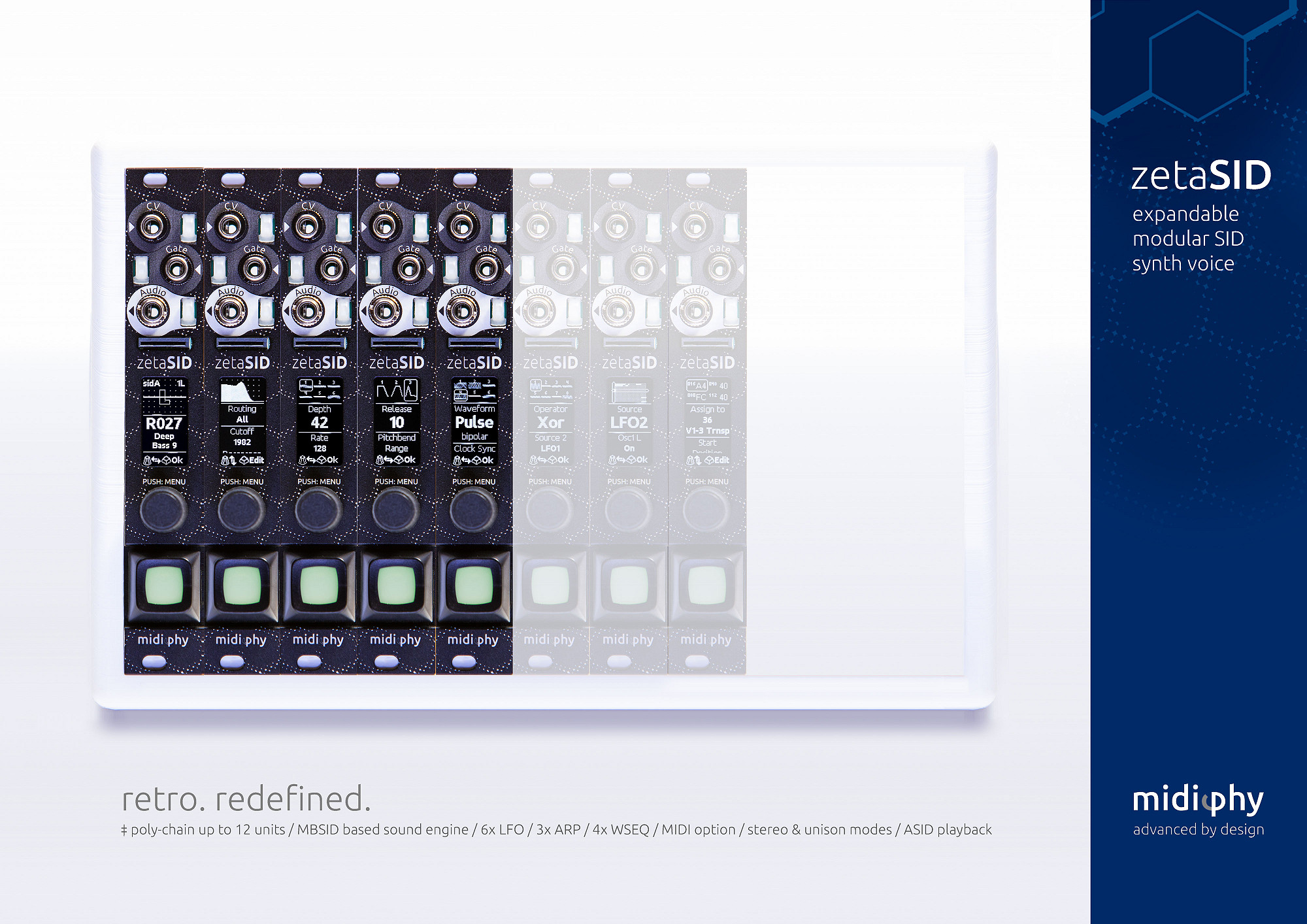
The user interface of zetaSID was designed to be intuitive and cooperative. As shown in the picture, you can use individual zetaSIDs for different configuration tasks within your shared polyphonic SID sound engine patch: one zetaSID could adjust the filter, another could reconfigure the LFO rates, a third could set the event trigger matrix, a fourth could modify the oscillator voices, and so on. This cooperation model lets you dedicate one knob or button per patch section, reducing the need to menu-dive when designing new patches.
Expand via phybus
Adding a phybus expansion module allows for simplified polyphonic use comparable to a conventional MIDI synthesizer. ASID SID-file playback via MIDI is also supported. When expanding with nexusMIDI or linking multiple zetaSID modules, the now-unused CV and gate inputs can be repurposed as additional modulation sources.
The user interface of zetaSID was designed to be intuitive and cooperative. As shown in the picture, you can use individual zetaSIDs for different configuration tasks within your shared polyphonic SID sound engine patch: one zetaSID could adjust the filter, another could reconfigure the LFO rates, a third could set the event trigger matrix, a fourth could modify the oscillator voices, and so on. This cooperation model lets you dedicate one knob or button per patch section, reducing the need to menu-dive when designing new patches.
Expand via phybus
Adding a phybus expansion module allows for simplified polyphonic use comparable to a conventional MIDI synthesizer. ASID SID-file playback via MIDI is also supported. When expanding with nexusMIDI or linking multiple zetaSID modules, the now-unused CV and gate inputs can be repurposed as additional modulation sources.
Features
One of the world's most powerful SID sound engines: based on MIDIbox SID, offering six LFOs, eight modulation paths, two envelopes (with delay, multi-stage attack, decay, and release phases, plus envelope curve shape control), four integrated wave sequencers to animate patch sound progression over time, three independent oscillator arpeggiators, and a powerful 24x14 event trigger matrix for vast sound design options within the Lead sound engine.
Alternatively, the Drum sound engine with up to 16 different parallel instruments per zetaSID is available. Percussive sounds can be created from 19 parametric drum algorithms, ranging from bass drums to toms, snares, claps, and classic C64 sound effects, capturing the joy and fun of percussion sounds from that era.
Rack-space-saving 4HP minimalism with an intuitive graphical UI featuring fluid visualization of oscillator outputs, arpeggio patterns, filter curves, and more.
Integrated ROM bank with 100 great-sounding preset patches.
State-of-the-art SID sound chip emulation for noise-free sounds faithful to the original chip output from the 1980s.
Stereo sound engine design: link two zetaSIDs via phybus for a true stereo instrument voice. Most patches take advantage of the engine's stereo capabilities.
Stereo voice polychaining: chain up to twelve zetaSID modules in a phybus instrument cluster for six polyphonic stereo voices.
Multi-SID unison mode: link multiple zetaSIDs and individually detune them for an incredibly fat unison sound.
User interface expansion: use phybus UI cooperation to adjust different sections of the same patch on multiple zetaSIDs simultaneously, e.g. work on filter, oscillators, and LFOs on different modules at the same time. This lets you extend the user interface of a single unit significantly and assign different configuration duties to different zetaSIDs.
Integrated advanced per-oscillator arpeggiators with individually configurable and syncable clock speeds and powerful arpeggio parameters for classic chiptune sounds: from slow arp sequences to high-speed multi-octave performances.
Integrated quad wave sequencer: based on an original C64 sound generation technique called "wavetables" (unrelated to modern wavetable synthesis), this allows step-wise modulation of SID patch parameters with a multitude of options, e.g. fine-grained adjustments of oscillator pitches over time using absolute or relative sequencer values for each step. Four wave sequencers per patch with individually configurable playback speeds are available.
Optional MIDI expansion: use nexusMIDI to expand your zetaSID instrument cluster with additional MIDI ports and free up the integrated CV input ports for additional modulation sources from your eurorack system.
Patch virtual cords between your midiphy modules using phybus. This reduces cable clutter and allows for total recall (a microSD card is required to save/recall sessions).
Limited compatibility with existing community MBSID v2 Lead and Drum patches (without sequencer), which can be stored and loaded in their original SysEx file format (a microSD card is required to save/load patches).
One of the world's most powerful SID sound engines: based on MIDIbox SID, offering six LFOs, eight modulation paths, two envelopes (with delay, multi-stage attack, decay, and release phases, plus envelope curve shape control), four integrated wave sequencers to animate patch sound progression over time, three independent oscillator arpeggiators, and a powerful 24x14 event trigger matrix for vast sound design options within the Lead sound engine.
Alternatively, the Drum sound engine with up to 16 different parallel instruments per zetaSID is available. Percussive sounds can be created from 19 parametric drum algorithms, ranging from bass drums to toms, snares, claps, and classic C64 sound effects, capturing the joy and fun of percussion sounds from that era.
Rack-space-saving 4HP minimalism with an intuitive graphical UI featuring fluid visualization of oscillator outputs, arpeggio patterns, filter curves, and more.
Integrated ROM bank with 100 great-sounding preset patches.
State-of-the-art SID sound chip emulation for noise-free sounds faithful to the original chip output from the 1980s.
Stereo sound engine design: link two zetaSIDs via phybus for a true stereo instrument voice. Most patches take advantage of the engine's stereo capabilities.
Stereo voice polychaining: chain up to twelve zetaSID modules in a phybus instrument cluster for six polyphonic stereo voices.
Multi-SID unison mode: link multiple zetaSIDs and individually detune them for an incredibly fat unison sound.
User interface expansion: use phybus UI cooperation to adjust different sections of the same patch on multiple zetaSIDs simultaneously, e.g. work on filter, oscillators, and LFOs on different modules at the same time. This lets you extend the user interface of a single unit significantly and assign different configuration duties to different zetaSIDs.
Integrated advanced per-oscillator arpeggiators with individually configurable and syncable clock speeds and powerful arpeggio parameters for classic chiptune sounds: from slow arp sequences to high-speed multi-octave performances.
Integrated quad wave sequencer: based on an original C64 sound generation technique called "wavetables" (unrelated to modern wavetable synthesis), this allows step-wise modulation of SID patch parameters with a multitude of options, e.g. fine-grained adjustments of oscillator pitches over time using absolute or relative sequencer values for each step. Four wave sequencers per patch with individually configurable playback speeds are available.
Optional MIDI expansion: use nexusMIDI to expand your zetaSID instrument cluster with additional MIDI ports and free up the integrated CV input ports for additional modulation sources from your eurorack system.
Patch virtual cords between your midiphy modules using phybus. This reduces cable clutter and allows for total recall (a microSD card is required to save/recall sessions).
Limited compatibility with existing community MBSID v2 Lead and Drum patches (without sequencer), which can be stored and loaded in their original SysEx file format (a microSD card is required to save/load patches).
zetaSID technical data
width: 4 HP
depth: 30 mm (with cables)
panel: high-quality milled aluminium front panel (no PCB material)
power connector: standard eurorack +/–12V 10-pin IDC
power consumption: +12V: 120mA | –12V: 15mA | 5V: 0mA/not required
storage (optional): microSD card 10/A1 or faster; FAT32 format
physical inputs: CV in (–5V to +5V or 0 to 10V configurable) / gate in
physical outputs: audio output (eurorack-level audio)
phybus inputs: MIDI in 1, 2 / note gate / drum trig 1–4 / note pitch, LFO1 depth, filter cutoff
phybus outputs: MIDI out
maximum instrument cluster size: 12 zetaSID units (6 stereo voices)
maximum phybus network size: 16 modules
maximum total phybus cable length: 150 cm
zetaSID flyer
width: 4 HP
depth: 30 mm (with cables)
panel: high-quality milled aluminium front panel (no PCB material)
power connector: standard eurorack +/–12V 10-pin IDC
power consumption: +12V: 120mA | –12V: 15mA | 5V: 0mA/not required
storage (optional): microSD card 10/A1 or faster; FAT32 format
physical inputs: CV in (–5V to +5V or 0 to 10V configurable) / gate in
physical outputs: audio output (eurorack-level audio)
phybus inputs: MIDI in 1, 2 / note gate / drum trig 1–4 / note pitch, LFO1 depth, filter cutoff
phybus outputs: MIDI out
maximum instrument cluster size: 12 zetaSID units (6 stereo voices)
maximum phybus network size: 16 modules
maximum total phybus cable length: 150 cm
zetaSID flyer
zetaSID flyer download
zetaSID-flyer.pdf (4.92M)